
EcoKuku
Incubators Chicks Equipment Why Us Learning Hub 📅 Book a Farm Visit 📞 +254 710 905 696
Commercial Broilers

Commercial Broiler Chicks in Kenya

Purpose-bred for fast, heavy meat production. A well-managed broiler flock reaches market weight in 6 weeks. The fastest return on investment in poultry farming — if you manage them right.

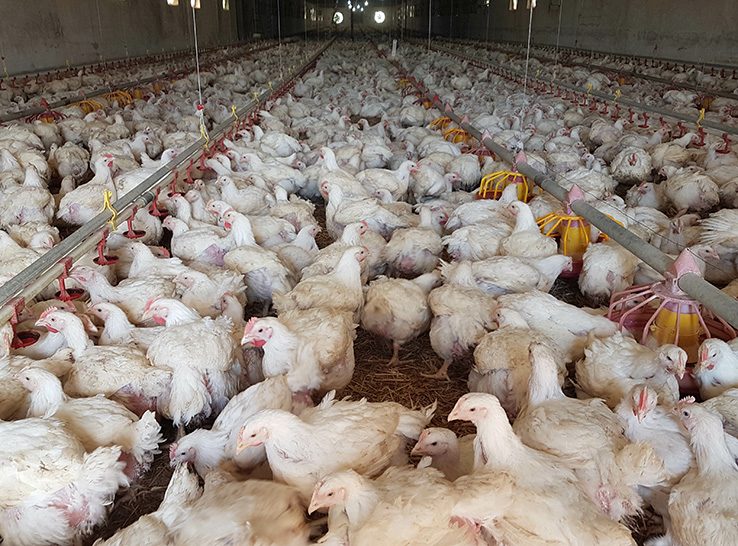
Commercial broiler chickens Kenya — EcoKuku Farm Ltd
6 wks
To market weight
2.5 kg
Average slaughter weight
1.8:1
Feed conversion ratio
8x
Cycles per year
How to Raise Broilers

The 6-Week Broiler Cycle — Week by Week

Broilers are the most unforgiving bird to manage. Every week has specific requirements. Miss one and your feed conversion suffers — which means your profit margin shrinks.

1–2
Weeks
Week 1–2 · Brooding

Critical First 14 Days

This is where most broiler farmers lose money. Chicks arrive dehydrated and cold from transport. First action: give warm water with glucose or sugar before you give any feed — this restores energy. Brooder temperature must be exactly 33°C on day 1. Use a thermometer, not guesswork. Watch the chicks: if they crowd under the heat source they are cold — raise the brooder. If they spread to the edges and pant they are hot — lower it. Spread throughout the brooder means temperature is correct. Floor space: at least 0.1 square metres per chick in week 1. Use broiler starter mash (23–24% protein) and keep feeders and drinkers low enough for chicks to reach. Clean water available 24 hours. Vaccinate for Newcastle at day 7 via eye drop — do not miss this.

33°C day 1 → 30°C day 7 → watch chick behaviour
Glucose water before first feed — restores energy
Broiler starter mash 23–24% protein, ad libitum
Newcastle vaccine day 7 — eye drop method
3–4
Weeks
Week 3–4 · Growth Phase

Maximum Feed Intake

By week 3 your broilers should weigh 700–900g. This is their fastest growth period. Switch to broiler finisher mash (20% protein) at the start of week 3 — it is cheaper than starter and sufficient for the growth phase. Give birds 23 hours of light and 1 hour of darkness per day — light drives feeding behaviour and growth. By week 4 your birds should be around 1.4–1.6kg. Ventilation is critical now: larger birds produce more heat and ammonia. Open sides of the brooder house or use fans. Ammonia from droppings causes respiratory infections that slow growth dramatically. Separate any sick or slow-growing birds immediately — they eat feed and spread disease without growing.

Switch to broiler finisher mash at week 3
23 hours light per day to maximise feed intake
Target weight: 700–900g at week 3, 1.4–1.6kg at week 4
Ventilation critical — ammonia kills growth rate
Commercial broilers at market weight Kenya
Week 5–6 · Finishing

To Market Weight

Week 5–6 is finishing. Your birds should be 2–2.5kg by end of week 6. Withhold feed for 6–8 hours before slaughter — empty crop and gizzard improves carcass quality and reduces contamination risk during processing. Do not withhold water until 2 hours before slaughter — water restriction stresses birds and shrinks the carcass. Weigh a sample of birds at day 35 and day 42. If average weight is below target by more than 15%, something is wrong: check feed quality, check water availability, check for respiratory disease signs. Plan your market before slaughter — broilers deteriorate fast without refrigeration. Sell live, slaughter on-farm, or supply to a buyer who collects. Calculate your feed conversion ratio: total feed used divided by total live weight gained. A good FCR is 1.8–2.0. Above 2.5 means something was wrong with your management.

Target 2–2.5kg at week 6
Withhold feed 6–8 hrs before slaughter — not water
Good FCR: 1.8–2.0 kg feed per kg weight gain
Plan your market before slaughter day
Profit Calculator
100 birds, 6 weeks
Profitability · 100 Birds

What to Expect per Cycle

With 100 broiler chicks, here is a realistic breakdown for one 6-week cycle in Kenya. Assume 95% survival (5 losses), so 95 birds at 2.2kg average = 209kg live weight. At KShs 350/kg live, revenue is KShs 73,150. Feed cost: 100 chicks × 4.5kg feed each = 450kg feed. At KShs 75/kg finisher, that is KShs 33,750. Chick cost: 100 × KShs 110 = KShs 11,000. Vaccines, medication, bedding: approximately KShs 3,000. Total costs: KShs 48,750. Gross profit: KShs 24,400 per 6-week cycle. That is 8 cycles per year if you manage turnaround efficiently — KShs 195,000+ gross per year from 100 birds. Scale to 500 birds and the economics improve significantly due to fixed cost spreading.

100 birds → approx KShs 24,000 gross profit per cycle
8 cycles possible per year
Margins improve significantly at 500+ birds
Use our homepage calculator for your exact numbers
Disease Management

The 3 Diseases That Kill Broiler Profits

Newcastle Disease

Sudden death with no warning. Vaccinate on day 7 via eye drop. Booster at week 4. No treatment once outbreak starts — your only protection is vaccination timing.

Coccidiosis

Bloody droppings, slow growth, high mortality from week 3 onward. Caused by wet litter and overcrowding. Keep litter dry and change frequently. Use coccidiostats in starter feed.

Respiratory Disease

Gasping, gurgling, nasal discharge. Caused by ammonia build-up and poor ventilation. Treat with Doxycycline or Tylosin from a vet. Prevention: open your house sides and control stocking density.

Prices

Broiler Chick Prices — Day-Old Only

📅
Day-Old Chicks Only — Available Tuesdays & Thursdays
We sell broiler chicks at day-old only. Batches are available every Tuesday and Thursday. Call ahead to reserve — batches sell out quickly. Free delivery to all 47 counties.
Commercial Broilers
Day-Old Chicks — Single Price
Tue & Thu
Day-Old Broiler Chick
KShs 110
Free delivery · All 47 counties

Minimum order quantities may apply for free delivery. Call +254 710 905 696 to confirm your batch and delivery date.

Ready to start your broiler cycle?

Call us to confirm current broiler chick availability. Free delivery to all 47 counties. We advise you on setup at no extra cost.

See All Breeds